
What many people associate with Korea today are trendy K-pop idols, tech-savvy consumers, and a globally influential beauty industry, often centered around the Seoul metropolitan area.
Far to the southwest of the Korean Peninsula, however, a very different reality exists. Here, groups of women enter the ocean without oxygen tanks, relying only on breath-holding, experience, and an intimate knowledge of the sea.
These women are called Haenyeo, meaning “women of the sea”—a centuries-old community of free divers who harvest seafood by hand and have long supported their families and fishing villages through their labor.
Haenyeo culture is often described as rare, resilient, and deeply communal. What is less widely known today is that, on rare occasions, outsiders—especially foreigners not originally from Korea—are also allowed to enter this tightly knit world.
Kylie is one of them. She is currently an intern Haenyeo diver in Yeongrak-ri, a fishing village in southwestern Jeju.
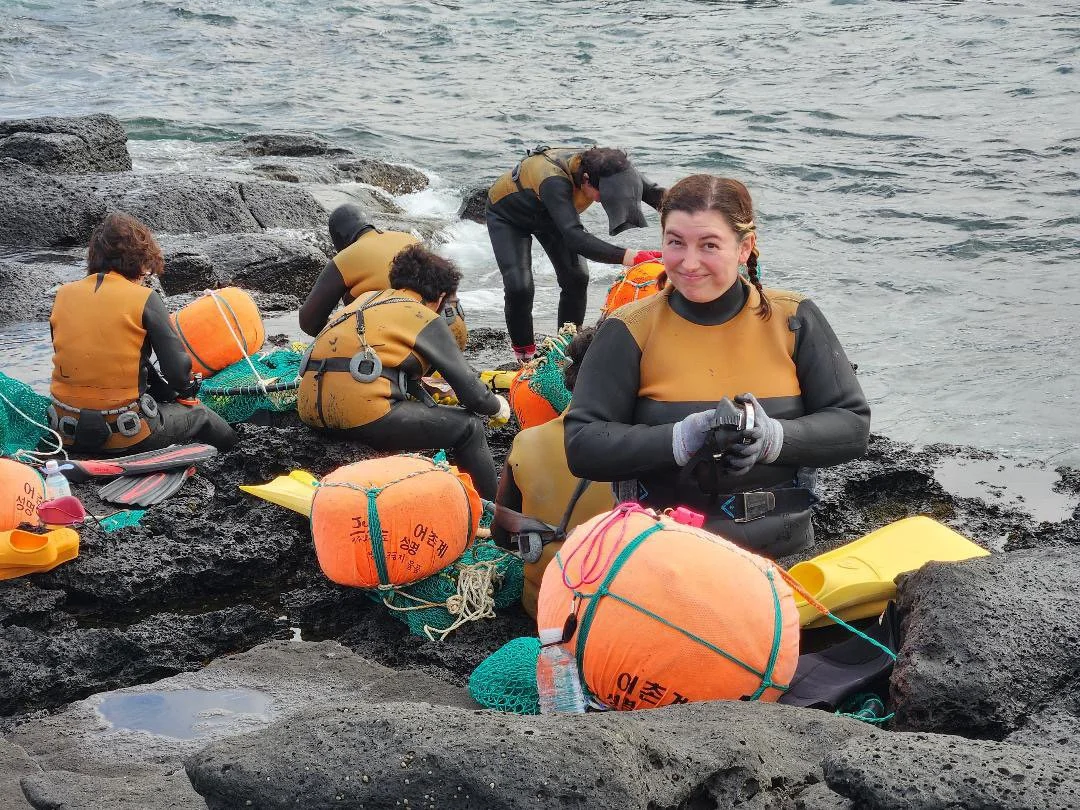
From New York State to Jeju Island
“I grew up in New York—the state, not the city.”
She clarifies with a laugh. She moved to South Korea in 2012, right after graduating from college, knowing very little about the country.
“It was the year ‘Gangnam Style’ went viral in the U.S. That was basically all I knew about Korea.”
She began her life in Korea on the mainland, living in a small city called Jinju in Gyeongsangnam-do, where she worked as an English teacher for four years. Later, she moved to Jeju Island—not because of the sea, but because of work.
At the time, she was employed by an organization that offered English-language educational tours of Jeju to Korean students. Among a team of four teachers, Kylie was the only woman.
“I figured that if we were going to develop a program about Haenyeo, I should be the one to work on it.”
That decision became her first step toward a much deeper relationship with the Haenyeo.
Entering Haenyeo School
In 2018, a Korean friend encouraged Kylie to apply to one of Jeju’s Haenyeo schools. There are two Schools designed to preserve traditional diving knowledge and pass it on to new generations.
“At first, I thought it would just help me understand Haenyeo culture better,” she says. “I was curious.”
She applied and was accepted.
Becoming a Haenyeo was still not the plan. Even after graduating from the Haenyeo School, she continued teaching English until 2020. Then she got married, left her full-time job, and began running a small guesthouse (called a pension in Korea) with her husband.
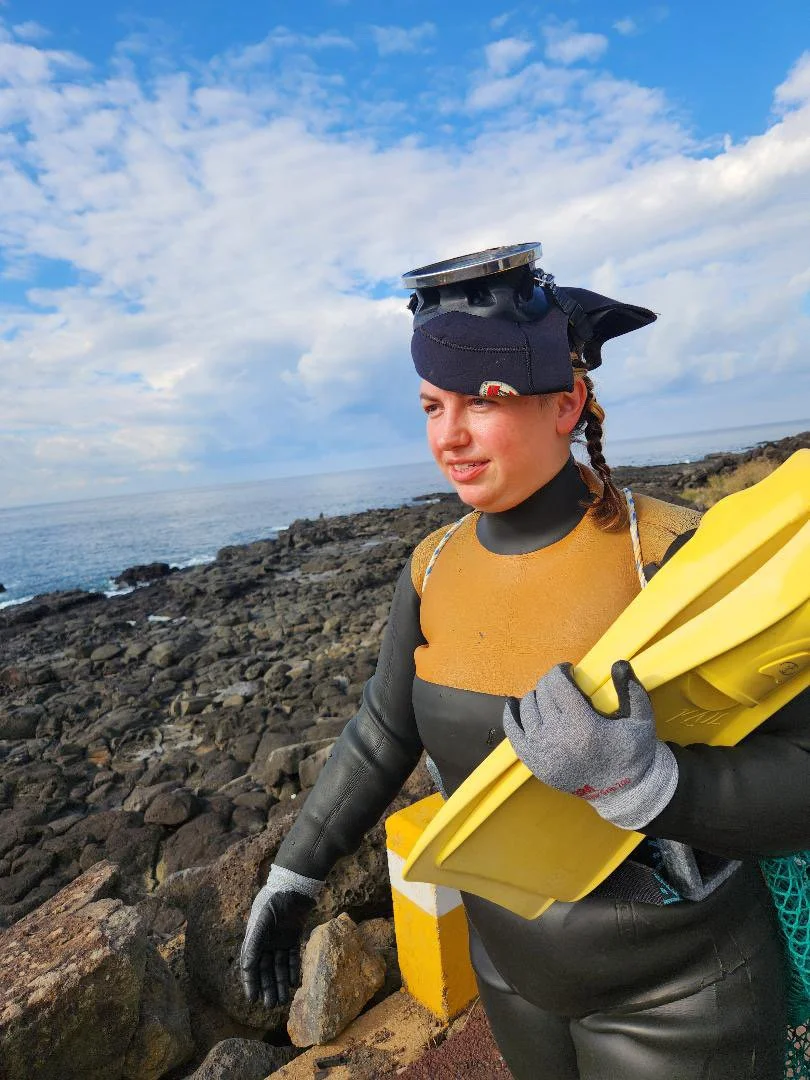
“Would You Consider Becoming a Haenyeo?”
At the end of 2023, an unexpected question changed everything.
A mutual friend reached out to Kylie and her husband—who is a scuba diving instructor—and asked if either of them would consider becoming a Haenyeo for Kylie and Haenam for her husband.
“I didn’t even know if it was possible,” Kylie recalls.
At first, it wasn’t. The village they contacted decided not to recruit new divers. Then another connection appeared.
“A friend of a friend told me she had moved to Yeongrak-ri and that the village was looking for new Haenyeo.”
Kylie expressed interest, but when the topic of accepting foreigners came up, the answer was initially no.
“One month later, the fishery chief called me and asked if I could come in for an interview.”
She did. She was approved. And quietly, without ceremony, she entered a world that few outsiders ever do.
Being Accepted, Not Choosing
Jeju has more than 100 Haenyeo village communities, each with its own rules, rhythms, and relationships.
“I don’t think I was really in a position to be picky,” she says honestly. “There probably aren’t many villages that would have accepted me.”
What stays with her most is gratitude.
“The women I dive with were willing to take a chance on me and open their hearts. That’s not something I take lightly. I feel incredibly lucky.”
A Life Controlled by the Weather
One of the biggest challenges in her life since becoming a Haenyeo has nothing to do with diving skills.
It’s tide and weather.
“We can only dive on certain days, and our area is extremely windy. A lot of dives get canceled.” Her schedule must remain open, flexible, and dictated by sea conditions.
“It can be frustrating,” she admits. “But when your work is tied to nature, that’s just reality.”
Language, Culture, and Trust
Surprisingly, the most difficult challenge Kylie faces is not physical—it’s linguistic.
Jeju has its own dialect, known as the Jeju dialect (제주 사투리), which is significantly different from standard Korean.
“My Korean isn’t perfect to begin with, and Jeju dialect is on another level,” she says. “I nod and smile a lot—but I’m learning.”
Over time, she’s noticed something unexpected.
“Some of the women seem more comfortable asking me for help because my Korean isn’t very good.”
If they need help walking, changing clothes, or doing something physically vulnerable, there’s less hesitation.
“I’m not someone they worry about gossiping,” she says gently. “I think that gives them a sense of ease.”
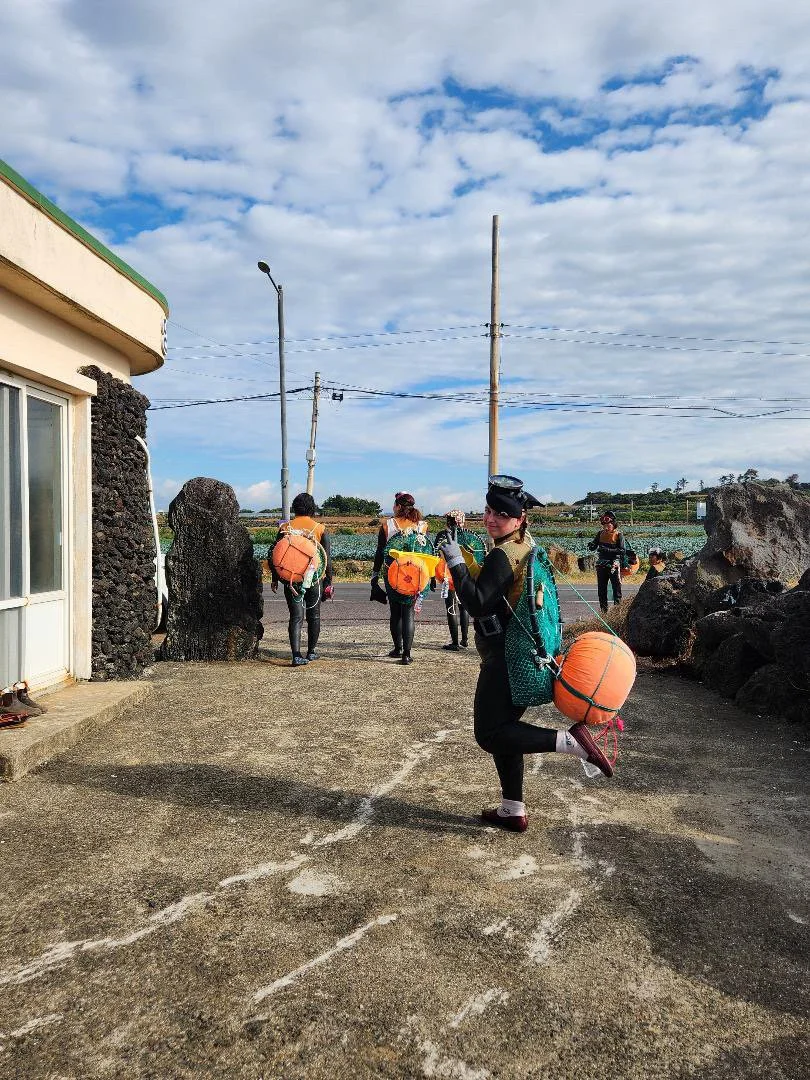
First Catches, First Fears
When asked about a moment she felt so proud as a Haenyeo, Kylie immediately thinks of her first catch.
“The first time I caught an octopus—or an abalone.”
Most of the time, the divers collect conches, which are relatively easy to spot. But the octopus was different.
“It started screaming when I surfaced,” she laughs. “It was moving around on my 까구리—the hook tool we use—and I was honestly scared.”
Fear, excitement, pride—all at once.
Journey as Migook Haenyeo (American Haenyeo)
Kylie’s story is a journey of earning trust, adapting to a new culture, and learning how to belong within a community that values humility over attention.
Her path into Haenyeo life was shaped not by ambition, but by curiosity, patience, and a willingness to listen—to the women, and to the sea.
Before every Haenyeo can become officially registered with a village and legally allowed to work, they must complete one to two years as an apprentice or intern diver. Only after this period, and with approval from both the village and Jeju Island, can they receive an official Haenyeo certificate.
Kylie has now completed her second year as an intern and is awaiting formal acceptance from the village to be registered as an official Haenyeo. Her journey as Haenyeo is ongoing and can be followed on her Instagram @migookhaenyeo, where she shares insights into Haenyeo life and related vocabulary.
All photos credit by Jenna Lee Kim @mayor.jenna.explores
